






And finally… fun house
 Reading time: 5 minutes
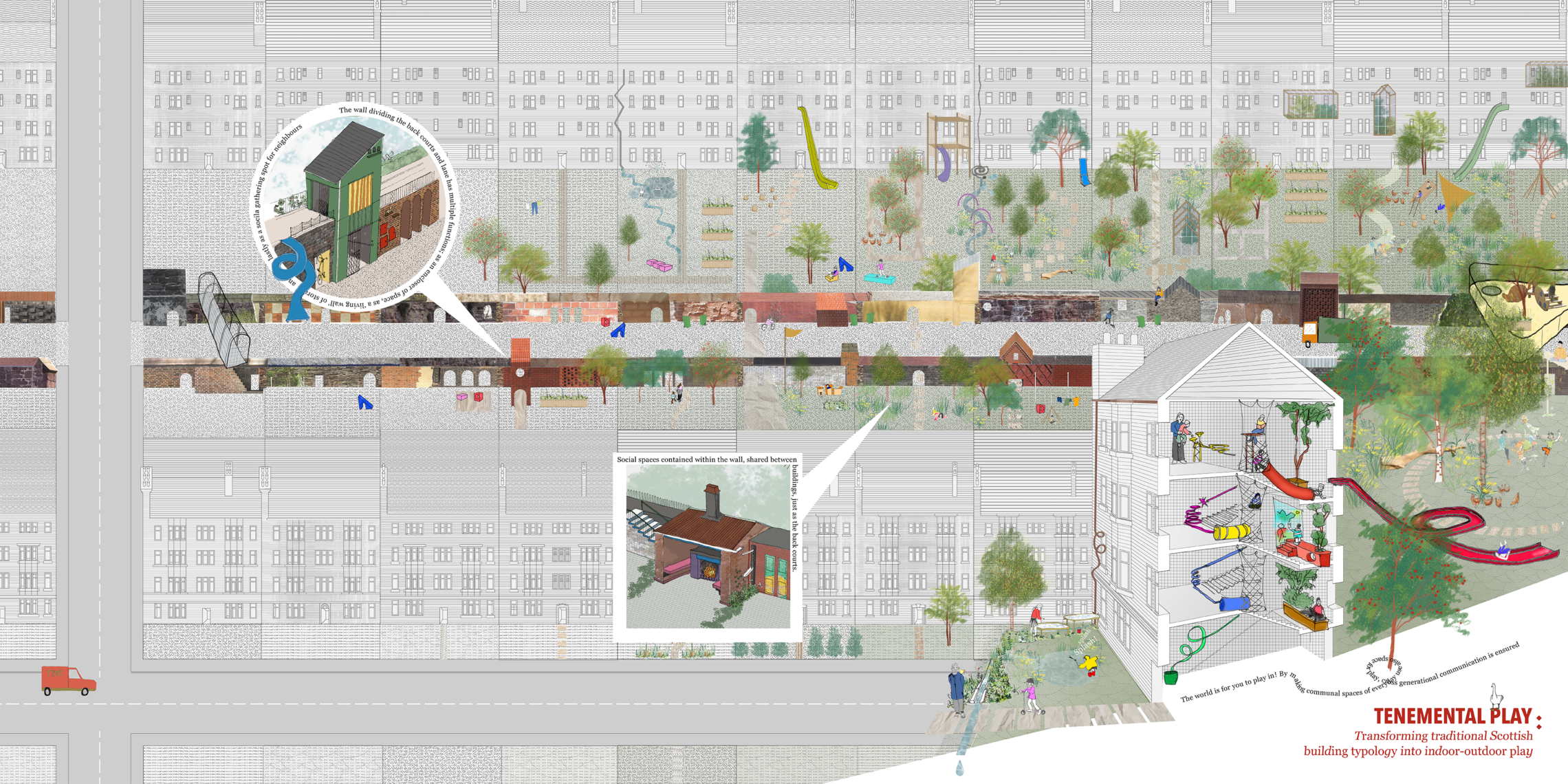
A playful take on a tenemental building has been shortlisted for this year’s Davidson Prize.
The submission from landscape architecture practice Erz, supported by architect Vas Piyasena, reimagines the Scottish tenement as a vibrant social infrastructure that supports climate resilience, collective care, and playful everyday life.
It transforms neglected communal spaces - closes, back courts, terraces, and lanes - into interactive, car-free areas with rain gardens, play features, urban sports, orchards, and shared amenities, fostering social connection and neighbourhood conviviality.


The Davidson Prize is an annual £25,000 design ideas competition recognising transformative architecture of the home. With a 2026 theme of Changing the Game: Building Play into Housing, the prize exists to celebrate innovative design ideas, to encourage multi-disciplinary collaboration and to promote compelling visual communication.
The ERZ entry is one of 12 to go head-to-head to win a £25k prize.
The full shortlist includes:
- Project 1: This is Not a Road: A community-led toolkit for Play
Team: Artform, CW Studio, Made It Together & Civic and Social
This is Not a Road reclaims residential streets as everyday spaces for play, inspired by grassroots activism that fought to protect community play spaces.
Through a flexible, community-led toolkit, it empowers residents to co-create playful, sociable streets - prioritising people over cars and embedding intergenerational activity into daily life. - Project 2: No Snakes, Just Ladders - Your second stairs can do more!
Team: Barr Gazetas, Trigon Fire Safety, atelier ANF, #toylikeme
No Snakes, Just Ladders reframes mandatory second staircases in tall housing as underused shared spaces rather than purely safety infrastructure.
It proposes transforming this required but idle volume into inclusive, playful environments that support everyday social interaction, making buildings work harder for residents beyond compliance. - Project 3: The (Connected) Great (Green) Park (Play) Estate
Team: BPTW with: Farrer Huxley, Julie Futcher, Arup, and Play Disrupt
The proposal creates a connected, climate-resilient linear park across post-war estates, integrating play, nature, and everyday movement into a continuous landscape.
By replacing barriers with green infrastructure and loose, natural elements, it embeds intergenerational play into daily life while enhancing biodiversity, flood management, and community connection. - Project 4: Tenemental Play: Transforming the iconic Scottish housing typology into an indoor playscape
Team: erz with Vasantha Piyasena
The project reimagines the Scottish tenement as a vibrant social infrastructure that supports climate resilience, collective care, and playful everyday life. It transforms neglected communal spaces—closes, back courts, terraces, and lanes—into interactive, car-free areas with rain gardens, play features, urban sports, orchards, and shared amenities, fostering social connection and neighbourhood conviviality. - Project 5: Court Rules
Team: Field Section LLP + Dr Asa Roast + Studio Zine
Garage courts in post-war housing are underused, overlooked shared spaces behind homes. Court Rules proposes residents collectively manage them through renewable licences, using simple tools and evolving shared rules.
The project treats these courts as adaptable, community-run spaces where use and rules continuously change - an “infinite game” shaped by local participation and ongoing revision. - Project 6: RWP: Retrofitting Water Play
Team: India Aspin Studio & Helen Bickford, Education Officer, British Ecological Society
RWP: Retrofit Water Play reimagines rainwater as a shared resource, transforming runoff into interactive streams and play features that activate courtyards during rainfall.
By combining hands-on water play with ecological systems like permeable paving and rain gardens, it creates dynamic, community-focused spaces that also improve drainage, habitat, and microclimate. - Project 7: Slow Play
Team: Intervention Architecture, Parakeet & Oobe
Teen public spaces are dominated by activity-focused facilities like MUGAs and skateparks, mostly used by boys, leaving girls and marginalized youth underserved.
In Druids Heath, The Platform introduces soft, sheltered, biodiverse spaces that support inclusive, restorative, and social forms of play, nature connection, and slow, contemplative engagement. - Project 8: Toy Box
Team: Places not Postcodes
Many everyday spaces go unused because people feel unsure about permission, judgment, or participation - leaving both places and playthings idle.
Toy Box proposes a simple shift: place shared toys in accessible local spots, inviting spontaneous play and social use without needing formal permission or design intervention. - Project 9: Play Your Part
Team: Root and Erect, Fielden Clegg Bradley, Gemma Keaney
Play Your Part! repositions play as central to housing design, using a card-based system to explore how different people, places, and play types can interact in everyday spaces.
By encouraging empathy, experimentation, and intergenerational thinking, it helps designers and residents create more joyful, inclusive environments beyond standard design constraints. - Project 10: PLAYDECK
Team: R.U.A Studio
PLAYDECK repurposes redundant London buses into mobile, intergenerational playgrounds, bringing flexible play spaces directly into neighbourhoods with limited provision.
By reclaiming streets and using adaptable play elements, it creates community-owned, imaginative environments that embed play into everyday urban life. - Project 11: Mewsings on Play
Team: Urban Radicals with Sebastian Tiew, Derin Fadina and Webb Yates
Play streets and adventure playgrounds in South London have declined due to privatisation, austerity, and the displacement of young families.
Mewsings on Play proposes a Community Land Trust model that unlocks small urban sites to create affordable housing with shared spaces and rooftop commons, fostering collective governance and intergenerational play. - Project 12: Follow the Worm (to a place it calls home)
Team: Wiggle Works
“Follow the Worm” is a residential outdoor play strategy in Dukinfield for S.E.N. communities, using sensory, structured, and conceptual interventions to transform underused spaces into inclusive, playful environments.
With the worm motif guiding wayfinding, it creates a network of outdoor classrooms, playgrounds, and interactive installations that support physical, social, and imaginative development.
Vote here.





Share this article:

Subscribe to our newsletter to not miss articles like this one:
 SUBSCRIBE

