






And finally… heat beneath our feet
 Reading time: 5 minutes
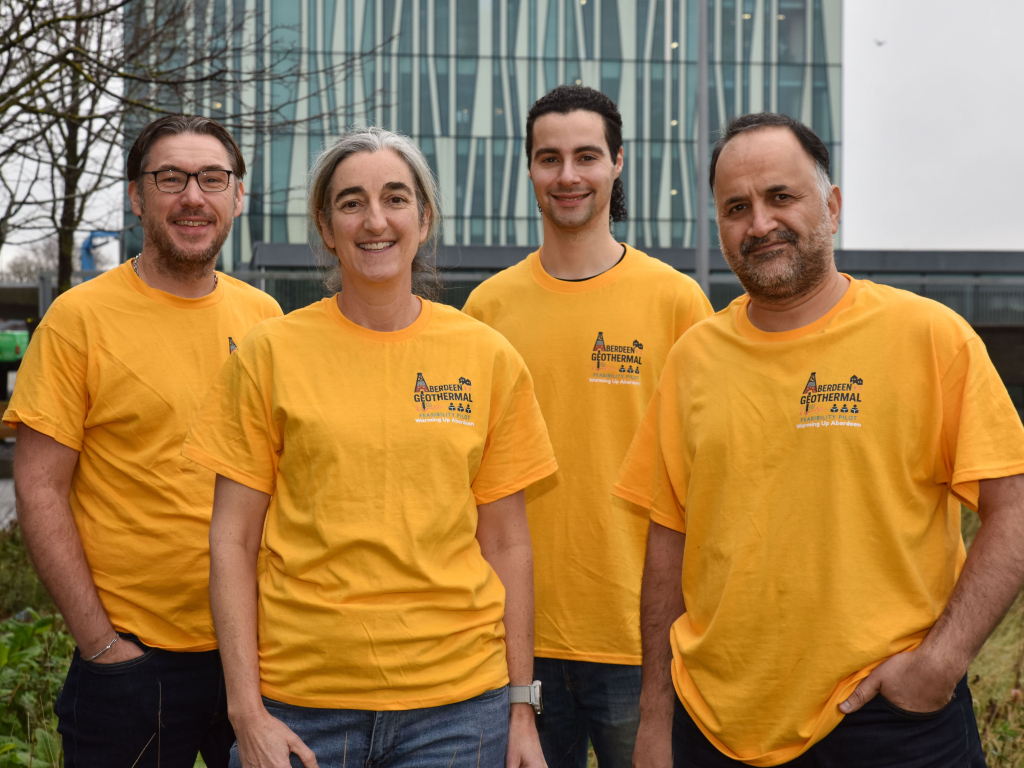
(from left) Dr David Cornwell, Professor Clare Bond, postgraduate researcher Tristan Roberts and Dr Vahid Vaziri
The University of Aberdeen has secured a £1 million public grant for a geothermal feasibility pilot study to unlock heat stored in the granite beneath the city that could one day provide a new source of warmth for homes.
The Aberdeen Geothermal Feasibility Pilot (AGFP) is an ambitious city-wide collaboration to explore Aberdeen’s geological potential and pave the way for low-carbon heating solutions.
Funded by UK Research and Innovation (UKRI) and led by the University of Aberdeen, subject to planning consent, the project will see an instrumented borehole drilled to a depth of over 500 metres on King’s College campus in Old Aberdeen.


Geothermal energy is the natural heat stored underground. The project does not fracture rock, inject high-pressure fluids, or attempt to find hydrocarbons. Instead, it plans to use standard, well-regulated scientific drilling techniques to measure temperature, geology and groundwater conditions and expand this knowledge to understand how heat flows through the rocks under the entire city.
“Desk studies have previously been carried out on Aberdeen’s geothermal potential,” said project co-lead Professor Clare Bond. “This project will be the first to provide the in-field geological data needed to help bring our initiative and others being considered across the city to reality.
“The borehole will provide direct subsurface temperature, geology and hydrology data and provide the startling point to test the potential for heat generated by granite at depth to be used to heat homes, the University and other buildings across the city.”
The borehole findings will be extended using a new 3D image of the rocks to 5km beneath the entire city. Natural and man-made vibrations from waves, wind and traffic will be collected over 1-2 months using over 100 small buried seismic nodes. This ‘seismic noise’ will map out the granite and other subsurface structures and ultimately show where geothermal heating will work best in Aberdeen.


Dr David Cornwell, project co-lead and seismologist, has been championing the potential for geothermal heat in the city, assembling a large group of interested and skilled collaborators to deliver the project and de-risk further geothermal developments.
“Coupling borehole data with the city-wide model will reveal the true potential of geothermal heating in Aberdeen,” he said. “The data we collect will be openly available, not just helping de-risk future geothermal investment and accelerating Aberdeen’s transition to a sustainable energy future but providing data that can be used to predict the geothermal potential of other places across the UK.”
Professor Louise Heathwaite, executive chair, UKRI Natural Environment Research Council (NERC), said: “This innovative project will support the UK’s transition to clean energy. By combining geoscience research with real-world application, the Aberdeen Geothermal Feasibility Pilot has the potential to transform heating solutions in Aberdeen.
“It could also provide a blueprint for geothermal potential in granite formations, that, with NERC’s UK Geoenergy Observatories (UKGEOS), will enhance geothermal development across the UK. NERC is pleased to support research that translates environmental science into tangible community benefits, particularly in addressing critical challenges like fuel poverty whilst advancing net zero ambitions.”


Interdisciplinary director for energy transition at the University, Professor John Underhill, added: “The award demonstrates the power of interdisciplinary working - in this case connecting geoscience and engineering - to provide clean energy solutions.
“If the pilot is successful, there is the potential to roll the initiative out across the city and use ground sourced heat for district heating in schools and across the wider community to tackle fuel poverty. In so doing, the University will be true to its foundational purpose of being in the service others.”
The UKRI funding enables the first phase of a larger vision to integrate geothermal into the city energy mix by integrating technical development and research as part of a just energy transition for all.
The team are looking to secure funding for subsequent phases of the AGFP project which will focus on re-assessing heat poverty information in Aberdeen to see where geothermal can contribute most effectively; empowering and equipping communities to lead on decisions regarding heating and energy in the city; and developing skills and understanding of geothermal to support job creation.
The pilot draws on expertise from the University of Aberdeen’s Estates & Facilities, Geosciences and Engineering Schools, and the Centre for Interdisciplinary Research and the Just Transition Lab, supported by a broad consortium of collaborator and partner organisations including NHS Grampian, Aberdeen City Council, Aberdeen Heat and Power, Robert Gordon University, Geosolutions Leeds at the University of Leeds, the British Geological Survey, TU Delft Netherlands, the National Geothermal Centre, the Net Zero Technology Centre and Aberdeen Renewable Energy Group, alongside several experienced and skilled geothermal industry partners and individuals.

Share this article:

Subscribe to our newsletter to not miss articles like this one:
 SUBSCRIBE

