





And finally… rise and design
 Reading time: 2 minutes
Photographer: Chalmers University of Technology | Henrik Sandsjö
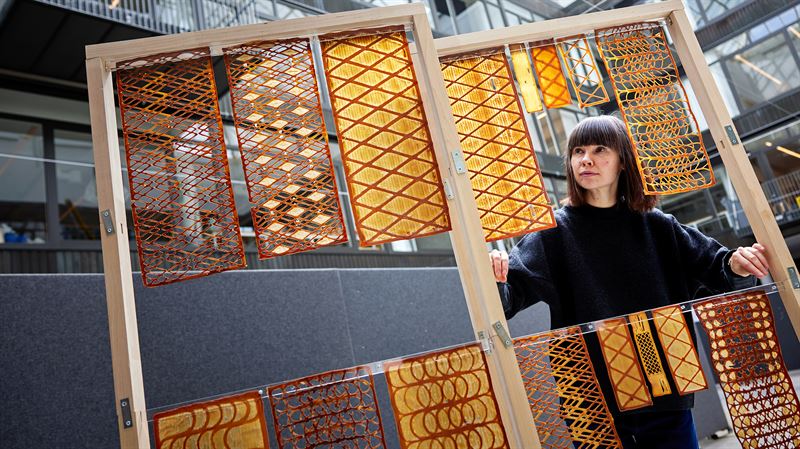
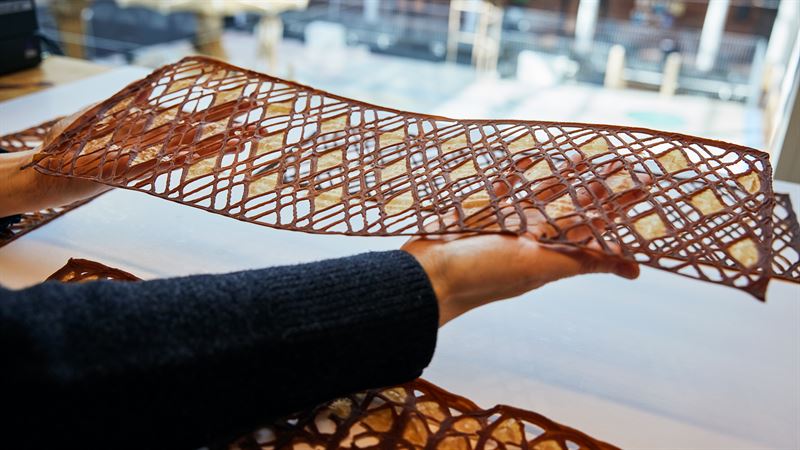
Researchers at Chalmers University of Technology have created a fully bio‑based, 3D‑printable architectural material made from an unlikely source — baker’s yeast. The hydrogel‑like mix, which also includes cellulose fibres, alginate and plant‑based glycerol, can be printed into interior elements that currently rely on plaster, plastics or synthetic textiles.
The project explores how industrial by‑products can be repurposed into circular, low‑carbon materials for the built environment. By deactivating the yeast and blending the ingredients into a smooth mass, the team can pressure‑print complex forms at room temperature without waste or support structures.
According to project lead Professor Malgorzata Zboinska, the work opens a new frontier in combining biomaterials with digital fabrication. Adjusting the formula allows designers to vary transparency, colour and texture, making the material suitable for screens, partitions and wall systems. Natural pigments — or even colourful yeast strains — can shift the palette from yellow to deep brown.


Photographer: Chalmers University of Technology | Henrik Sandsjö
Because yeast grows rapidly and is resilient to contamination, it offers a predictable biomass that provides volume, stability and strength. The researchers also see potential in using brewing and agricultural residues that cannot be repurposed as food or feed.
The material is biodegradable, challenging the assumption that architectural components must be designed for long lifespans. Instead, ageing and decomposition can be treated as part of the design cycle.
Further research will focus on strength, fire performance, moisture behaviour and scaling up production. The team also points to future possibilities in Engineered Living Materials, such as self‑healing components or air‑purifying surfaces.


The study, Novel 3D printable yeast‑based materials for architectural applications, is published in Frontiers of Architectural Research.



Share this article:

Subscribe to our newsletter to not miss articles like this one:
 SUBSCRIBE