



Capital funding to deliver remaining A9 dualling sections
 Reading time: 3 minutes

Transport secretary Fiona Hyslop MSP
The remaining sections of the A9 Dualling Programme will be delivered using capital funding, transport secretary Fiona Hyslop MSP has confirmed.
Reflecting the change in funding approach, the Scottish Government’s 2026 Delivery Plan has been published to cement a commitment to completing the programme by the end of 2035.
The new ordering for remaining sections within the 2026 Delivery Plan will bring forward work on three busy grade separated junctions serving Carrbridge and Aviemore, providing key safety benefits to local communities sooner than anticipated.


The junctions will be upgraded as part of the sixth section to enter construction in the Northern section between Dalraddy and Slochd. Once this section is complete in 2032, there will be around 38 miles (60.5km) of continuous dual carriageway between Inverness and Kincraig.
The new ordering within the 2026 Delivery Plan will accelerate the delivery of the grade separated junction at Dalnaspidal and work on the Aviemore to Carrbridge Non-Motorised User Route (ACNMU).
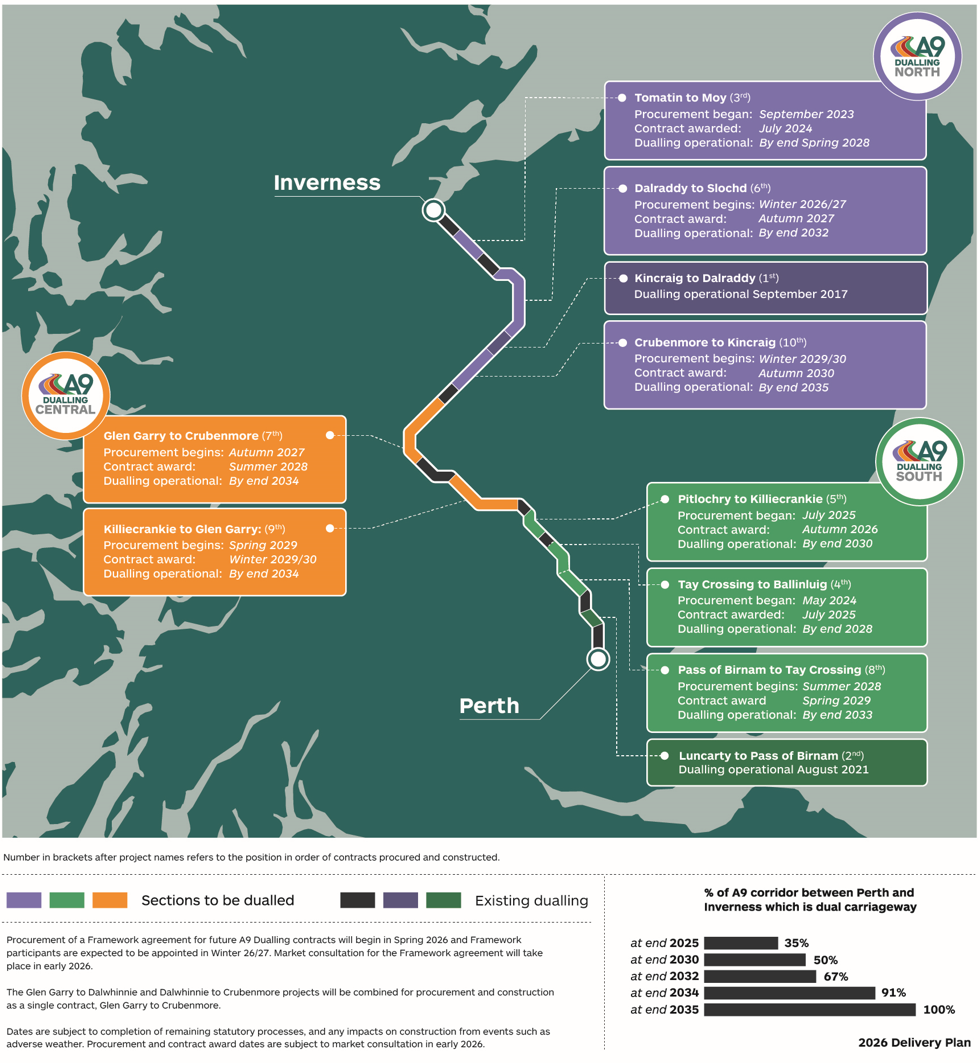
The procurement timeline for each section
The cabinet secretary also confirmed that a Framework Agreement will be established to streamline the procurement process, with all remaining sections of the dualling programme yet to commence procurement to be procured under the proposed Framework Agreement.


Cabinet secretary for transport, Fiona Hyslop MSP, said: “This announcement maintains the Scottish Government’s commitment to having dualling operational between Perth and Inverness by the end of 2035.
“Our 2026 Delivery Plan provides more detail and certainty for the market and brings forward key elements of the Programme in the North section of the Programme. This will be reassuring news for local communities in Aviemore and Carrbridge.
“With construction activity already taking place on 11 miles of the corridor, our plan will continue to ramp up that work, with 50% of the route between Perth and Inverness to be operating as dual carriageway by the end of 2030 - rising to 67% by the end of 2032. With 100% dualling achieved by the end of 2035.
“The 2026 Delivery Plan and establishment of the Framework Agreement will be subject to further market consultation with the industry, which is expected to commence on 19 January 2026.


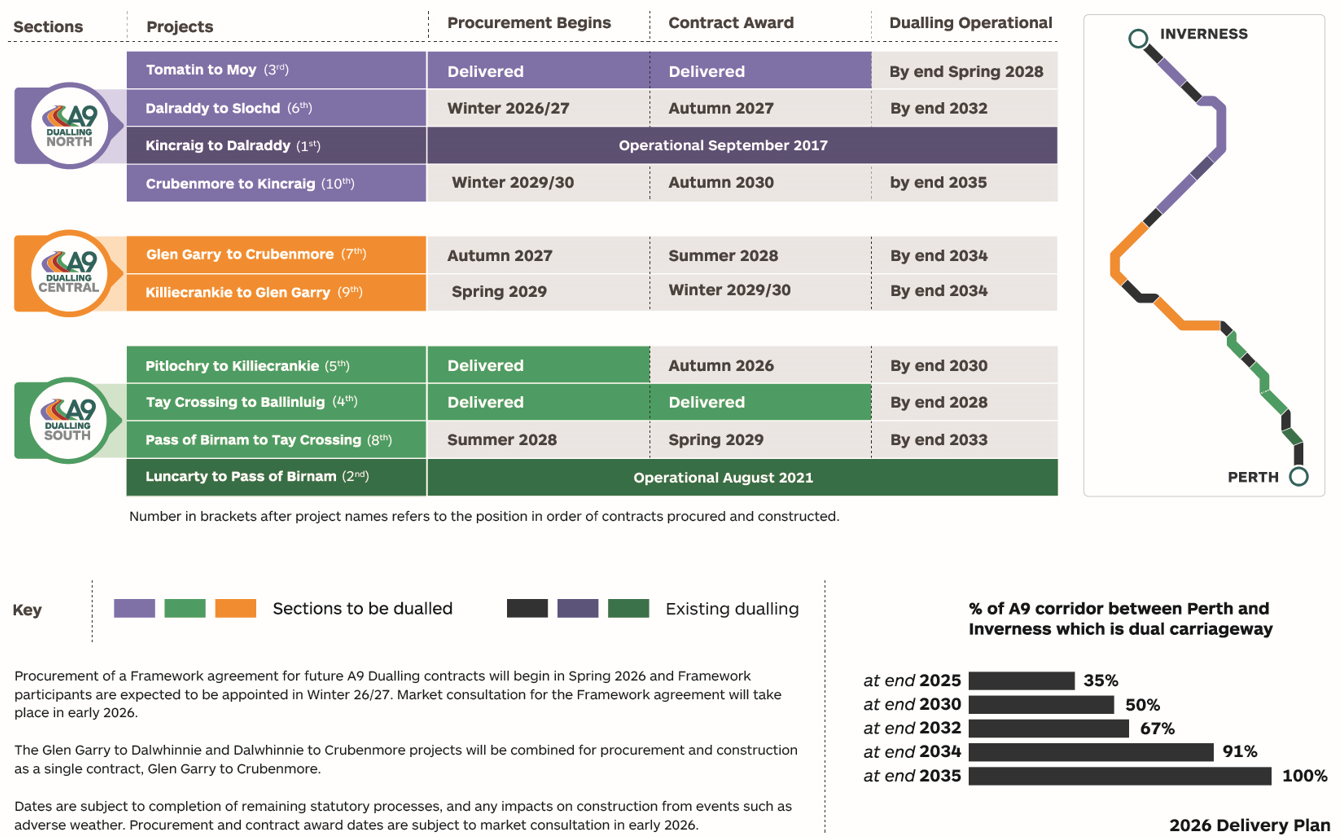
“It is expected the Framework will commence procurement in Spring 2026 with participants being appointed to the Framework by the end of 2026. This will assist in securing market capacity giving more certainty to communities and drivers that this Plan will complete dualling by 2035.”
David Macdonald, chairman, Civil Engineering Contractors Association (CECA) Scotland, said: “CECA welcomes the news that the remaining A9 Dualling Programme sections will be taken forward as capital-funded contracts, providing more certainty for Scotland’s contracting industry of the opportunities available on this major infrastructure programme for Scotland. We look forward to continuing to engage with Transport Scotland throughout the procurement process.”
This multi-billion investment to dual the A9 involves construction of over 130 new structures, over 300 utility diversions and moving approximately 20 million m3 of earthworks (equivalent to 8,000 Olympic swimming pools worth of material).
In addition to providing a safer, more resilient and reliable route through the Highlands, through its Social Value Programme, the A9 Dualling Programme will leave a lasting legacy of benefit to the economy through providing small and medium sized enterprises (SMEs) through subcontract opportunities and maximising opportunities for supported Businesses and social enterprises, creating new jobs including apprenticeships and graduate posts helping to create a skilled future workforce.
As well as contributing to improving green construction through prioritising the use of electric and low or zero carbon emissions vehicles on site where possible, carbon emission measurement, monitoring and reporting including targets and incentives for driving carbon savings.

Share this article:

Subscribe to our newsletter to not miss articles like this one:
 SUBSCRIBE