



Circular construction ‘vital for meeting 20-year net zero deadline’
 Reading time: 3 minutes

©Anderson Bell Christie
Significant change is needed across the construction industry to meet the national net zero emissions target by 2045, according to Anderson Bell + Christie (ABC).
In the second of five announcements to raise awareness of its new Balance white paper, the architecture practice has called for the Scottish Government to establish a framework for transition to circular construction that follows its Balance roadmaps.
For ABC director, Jonathan McQuillan, “with less than 20 years to the deadline, time is of the essence”.


The white paper identifies how architects can help clients to understand the cumulative environmental impact of their choices by assessing the environmental performance of their buildings throughout their entire lifecycle – including both embodied and operational carbon.
Whole Life Carbon - the total carbon emissions associated with a built asset throughout its entire lifecycle - can be calculated using stages defined by European standards EN 15978 and EN 15804. These stages are: A (creating and assembling materials), B (in use), C (end of life) and D (beyond end of life).
The research indicates that there are three main transitions that the construction industry must go through to achieve Net Zero Whole Life Carbon (Stages A – D).
It points to the initial gains that can be made by transitioning materials to lower embodied carbon options. There are a variety of solutions available on the market and natural materials with low energy fabrication processes present viable alternatives in most cases. Mainstreaming the use of these, in tandem with design efficiency, will increase availability and reduce cost, said ABC.


©Anderson Bell Christie
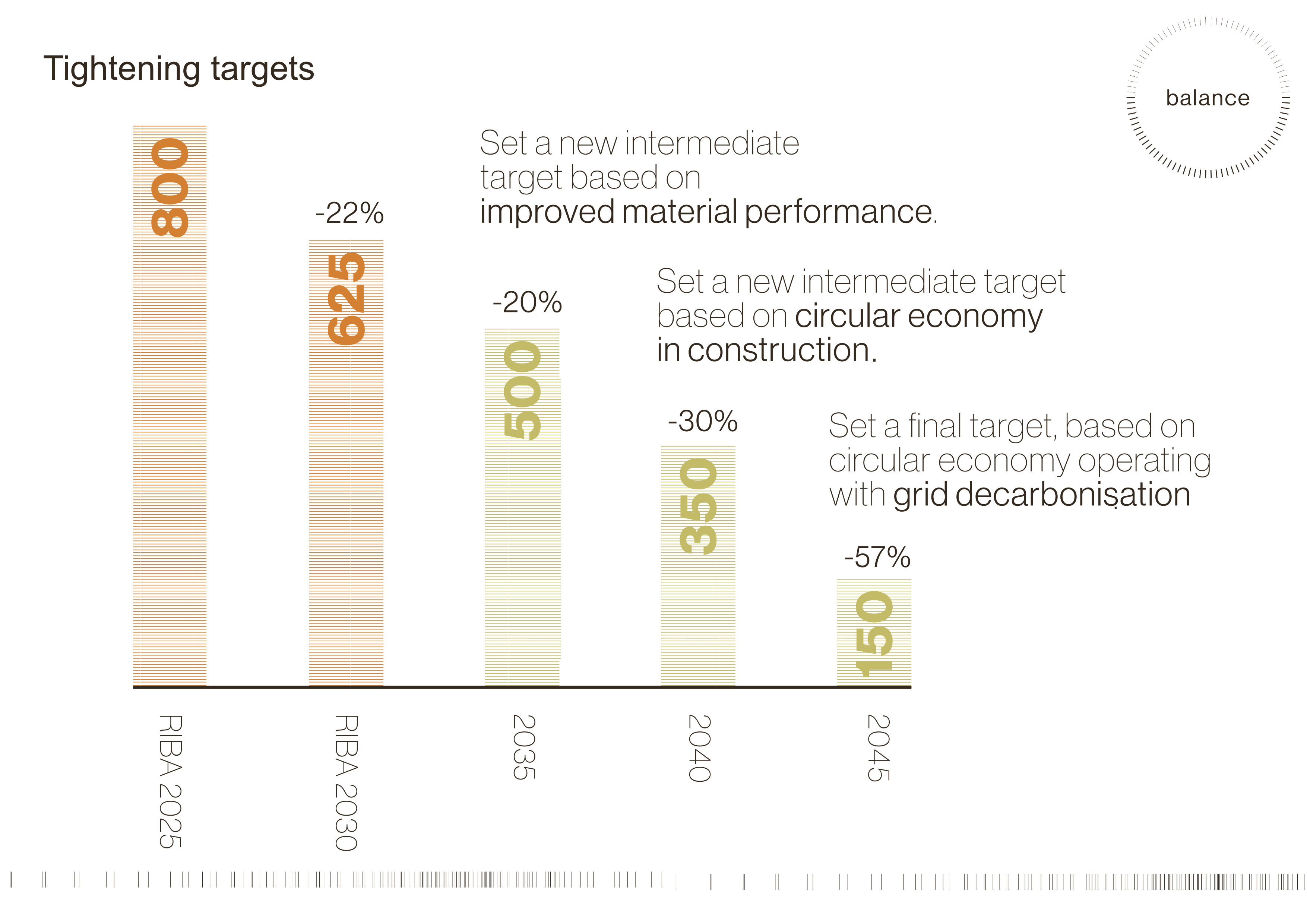
The second transition will see a move to circular construction. All lifecycle methodologies agree that inorganic materials are either sent to landfill, or undergo energy intensive recycling processes, they are not reclaimed and reused. Current lifecycle analysis assumes that at end of life (stages C1-4) most organic materials release their carbon back to the atmosphere.
ABC said this means that the carbon sequestered into the material at stages A1-3 is released back into the atmosphere in stages C1-4. This provides the imperative to plan for and action the reuse of materials.
ABC’s own life cycle analysis indicates that, to achieve true net zero, the entire construction industry must become circular. To achieve this next step, and to reduce embodied carbon, the practice said the construction industry must shift its focus from recycling to reclamation for reuse. “We must minimise disposal at Stage C4 and make full use of stage D (beyond end of life in our lifecycle analysis),” added ABC.


Grid decarbonisation provides the third transition, while mid-point milestones are in flux, a legislative backstop is set for 2045. Materials produced in the UK will have lower levels of embodied carbon because of this, but ABC said it is worth noting that over time these materials will represent a diminishing proportion of that used in construction. By 2045, a third of construction materials used in the UK are predicted to come from nations that are targeting net zero by 2060 and 2070. This will become apparent when material passports become commonplace, added the practice.
ABC director Jonathan McQuillan said the steps proposed in the white paper will cumulatively assist buildings to reach a whole life carbon position of 150kgCO2e/m2 (lifecycle stages A-D).
“We believe this is a reasonable and achievable figure for the construction industry which will enable net zero to be achieved using a local approach to carbon offset within Scotland,” he added.

Share this article:

Subscribe to our newsletter to not miss articles like this one:
 SUBSCRIBE