





Construction outlook improves for 2026 after subdued end to year
 Reading time: 3 minutes
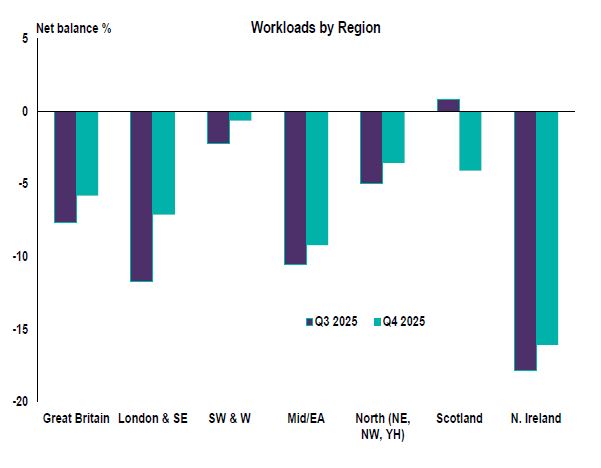
Overall construction activity in Scotland was relatively subdued through the final quarter of 2025, according to the latest Royal Institution of Chartered Surveyors (RICS) Construction Monitor, but Scottish respondents are more optimistic about the outlook for the year ahead.
A net balance of -4% of survey respondents reported a fall in construction workloads in Scotland in Q4 2025, down marginally from Q3 when the results of the survey reported workloads were broadly flat (a net balance of 1%).
Looking at the subsectors, a net balance of respondents indicated that there were falls in activity in both private housing (-9%) and private commercial (-10%) whilst activity in public housing, private industrials and other public works were all seen to be broadly flat. Infrastructure workloads continued to rise, with a net balance of 16% of respondents reporting an increase, up from 13% in Q3.


Looking ahead, a net balance of 24% of Scottish respondents expect overall workloads to rise over the next year, which is up from the 12% that was seen in Q3 and the highest this balance has been in over a year.
However, it appears that Scottish surveyors are cautious about the outlook for profit margins. A net balance of -6% of respondents anticipate profit margins will fall over the next year, though this is a modest improvement from the -10% that was reported in Q3.
Surveyors in Scotland continue to report skills shortages, albeit at a less severe rate than seen previously. 58% of survey respondents noted a shortage of quantity surveyors, down slightly from 60% in the last survey, 37% reported a shortage of bricklayers, down from 40% in Q3, and 33% report a shortage of other construction professionals, which is lower than the 44% reported in the survey prior.
Survey respondent Chris Marshall of Lundin Homes Ltd commented: “We are still experiencing major shortages in all sub-contractor trades resulting in higher costs to build new homes.”


Steven Hyde of D Blake & Co Ltd added: “Having previously said that recruitment and retention of trainee and skilled labour was the main issue we faced, we are now experiencing a drop in workloads and a reduced number of new tender enquiries.”
Commenting on the UK picture, Simon Rubinsohn, RICS chief economist, said: “The latest results provide little sign of a broad-based uplift in activity in the construction industry with respondents continuing to draw attention to challenges around planning and the building safety regime in particular, as well as viability related issues.
“The forward-looking metrics are a little more positive with workloads seen as likely to accelerate most notably in infrastructure driven by a pronounced increase in activity in the energy generation and distribution area as well as water.
“However, any pick-up in housing development is likely to be relatively modest and way short of what would be required to get anywhere near approaching the 1.5 million home target. While the passage of the Planning and Infrastructure Bill is seen as helpful for housebuilders, on its own it is not going to be sufficient to meaningfully move the dial.”



Share this article:

Subscribe to our newsletter to not miss articles like this one:
 SUBSCRIBE