




European planning leaders gather in Edinburgh to discuss Scotland’s role in climate and energy transition
 Reading time: 3 minutes
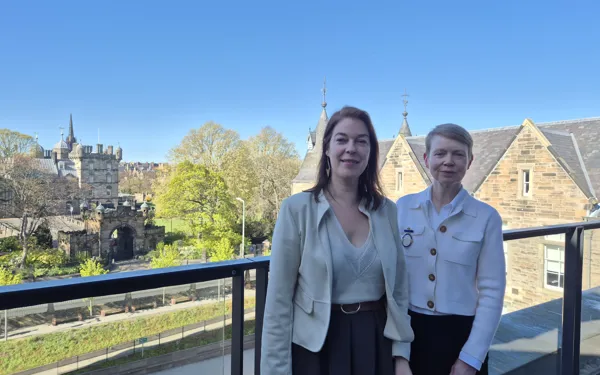
Catherine Vilquin and Jan Bessell
Senior planning professionals from across Europe gathered in Edinburgh to discuss how cities, regions and nations can respond to the climate emergency, deliver clean energy and build more resilient communities.
The General Assembly of the European Council of Spatial Planners – Conseil Européen des Urbanistes (ECTP-CEU) held in Scotland on 25 April, brought together delegates from across European countries and professional planning organisations.
Held at the Edinburgh Futures Institute, the event places Scotland at the centre of European discussions on planning reform, renewable energy and sustainable development.


A key focus of the Edinburgh conference was the role of planning in accelerating the transition to net zero while protecting communities and nature, including the transformation of the Shetland Islands from an oil-producing region to a leading renewable energy hub.
The Shetland session explained how decades of energy development have affected island communities and what lessons Scotland can share with the rest of Europe as countries expand offshore wind and new energy infrastructure.
Jan Bessell, president of the Royal Town Planning Institute and speaker at the conference, said: “Scotland has a strong international reputation for innovation in planning through place based leadership, sustainability, climate action and renewable energy, as well as strong research, innovation capability and emerging technology sectors.
“Bringing Europe’s planners together in Edinburgh allows us to learn from Scottish experience while sharing ideas from across the continent.”


Catherine Vilquin, president of the European Council of Spatial Planners – Conseil Européen des Urbanistes, added: “While today’s focus is on ‘Climate and Nature’, we must also recognise the wider global challenges shaping our future, including population growth, biodiversity loss and water scarcity.
“In this complex and interconnected context, planners are more essential than ever. Our strength lies in our ability to understand these diverse challenges, recognise their interdependencies, and bring clarity to complexity. By doing so, we can develop integrated strategies that respond meaningfully to today’s realities and strengthen the systems we depend on.”
Alongside the General Assembly, European representatives will also contribute to the Royal Town Planning Institute Scottish Young Planners’ Conference 2026, including an international panel discussion on how planning can address the climate and nature crises.
The gathering also recognises Scotland’s historic contribution to European planning cooperation, and in particular the role of the late Hugh Crawford in the history of the ECTP-CEU.


As one of the founding members, Hugh – who passed away in September 2025 – was instrumental in the establishment of the group. He hosted the first meeting of the group in Edinburgh with only five members, and then again in 2010 when the group celebrated 25 years.
Hugh’s passion and involvement in the cross-European conversation about planning continued until his death, just short of the 40th anniversary celebrations of the founding of the ECTP-CEU.

Share this article:

Subscribe to our newsletter to not miss articles like this one:
 SUBSCRIBE