




Written by:

Government ‘unlikely to meet’ affordable housing commitments within stated timescales
 Reading time: 7 minutes
Written by:
Scotland’s affordable housing ambitions face significant delivery challenges unless underlying pressures across the housing and construction sectors are addressed, new research by the Fraser of Allander Institute (FAI) has indicated.
Commissioned by the Scottish Federation of Housing Associations (SFHA) and the Association of Local Authority Chief Housing Officers (ALACHO), ‘An overview of the provision of affordable housing in Scotland’ examines the Scottish Government’s commitments to deliver 36,000 affordable homes by 2029/30, backed by £4.9 billion of investment, and 110,000 affordable homes by 2032.
The report finds that whilst the Scottish Government’s current funding commitments are broadly consistent with historical costings of affordable housing supply programmes, a lack of uprating to funding benchmarks makes delivery within the existing cost framework difficult for providers of affordable housing, such as housing associations and local authorities.


The FAI found that this challenge is particularly acute in rural and island communities – where higher construction and infrastructure costs can significantly increase development costs – but is becoming increasingly pertinent in urban areas too. The result is that housing associations and local authorities are facing growing financial shortfalls as inflationary pressures, workforce constraints, and wider fiscal challenges mean development costs rise faster than available funding and rental incomes.
The Institute’s research also suggests that under several different scenarios, the Scottish Government is unlikely to meet either of its affordable housing commitments within the stated timescales. Based on recent delivery trends, around 75,000 affordable homes could be completed by 2032, compared with the target of 110,000 homes.
The research highlights that affordable housing provision is shaped by a complex system involving government, local authorities, housing associations, and private- and third-sector contractors. While national targets provide strategic direction, delivery is determined by the capacity of the wider housing and construction sectors.
The report discusses Scotland’s construction sector and the challenges it faces, including material cost pressures, weak productivity growth, and workforce challenges that may constrain future housing delivery. Reconciling with financial pressures facing local authorities and housing associations suggests increases to funding alone – without addressing structural issues in the construction sector – may not be enough to meet affordable housing delivery targets.


The Institute conclude that while the Scottish Government’s housing targets reflect the scale of housing need across Scotland, achieving them will require policies that are more responsive to changing economic conditions and the practical realities of delivery.
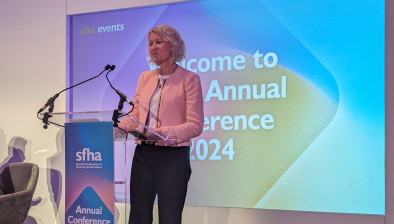
SFHA chief executive Richard Meade said: “This independent analysis from the Fraser of Allander Institute reveals that while the Scottish Government’s housing targets are ambitious, current conditions mean they are unlikely to be delivered. The analysis suggests that the headline target of delivering 110,000 affordable homes by 2032 is likely to fall short by around 35,000 homes unless action is taken to address rising building costs and capacity issues.
“Despite the significant work of housing associations, local authorities and delivery partners to build the homes Scotland needs, there remains a significant gap between targets set by the Scottish Government and the funding and capacity needed to deliver them.
“Sustained, long-term investment is essential and welcome, but as well as increased funding we need concrete steps to address the wider systemic challenges across the housing and construction sector which remain considerable barriers to progress.


“Affordable housing is critical national infrastructure and should be funded and planned as such. That means multi-year public investment that tracks real costs, closer partnership across the delivery system, and specific attention to capacity across planning, construction, and in rural and island communities where costs are highest and the gap is widest. Only then can we begin to bridge these substantial gaps.”
Tony Cain, policy manager at ALACHO, said: “Increasing the supply of affordable homes is an important part of the work to end the current housing emergency. This report has shown that, without urgent action to speed up delivery, the Scottish Government is unlikely to meet its affordable housing supply targets.
“Recent discussions around the new housing agency, More Homes Scotland, have made good progress. The agency will be key to the wider changes the report calls for. But councils need to be empowered to shape local investment programmes and develop tailored delivery responses if we are going to end the current emergency.”
Ben Cooper, economist fellow at The Fraser of Allander Institute, added: “Our research provides an important and timely assessment of the challenges facing affordable housing delivery in Scotland. While the Scottish Government’s targets reflect the scale of housing need across the country, our analysis shows that achieving these ambitions will be increasingly challenging without addressing the financial, workforce and capacity pressures affecting the housing and construction sectors.
“The report demonstrates that affordable housing delivery depends on a complex system of partners, funding mechanisms and market conditions, and highlights the need for policies that are responsive to the realities of delivery. We hope these findings contribute to a constructive conversation about how Scotland can best support the continued delivery of the affordable homes that are required.”
Homeless Network Scotland said the report confirms its belief that Scotland’s social housing programme has “stalled”.
Head of policy and impact Matt Hamill said: “These findings confirm what we have been saying for months. Scotland’s social housing programme has stalled and the result is that 250,000 people are stuck on housing waiting lists while councils spend tens of millions of pounds to keep people in the limbo of temporary accommodation, often costly, poor quality hostels and B&Bs.
“While the figures are deeply concerning, there is still time to turn this around before the 2032 deadline. This report must now serve as a wakeup call to policymakers and lead to a ramping up of housebuilding to deliver the 15,693 quality social homes every year of this new Parliament that expert research shows is needed.
“With the new Prime Minister pledging to place housebuilding at the heart of his agenda, every penny of Barnett consequentials that comes to Scotland as a result of that must be put towards Scotland’s own program of building.
“If the investment is on the table we know that the building industry, the planners and the supply chains will step up and meet the challenge. Scotland can exit the housing emergency, but the actions to do so must be underpinned by sufficient housing supply and today’s report shows that much work remains to get that done.”
The Scottish Government said it remains committed to the target and will consider the report’s findings in full.
Shirley-Anne Somerville, the cabinet secretary for social justice and housing, said: “This government is delivering on affordable housing, and we remain committed to our target of delivering 110,000 homes by 2032, which this report states is achievable.
“Latest figures show approvals up 42%, starts increasing by 37% and a 25% rise in new build starts for social sector housing compared to last year.
“Overall, since 2007 we have helped deliver 146,000 affordable homes and Scotland has delivered 45% more affordable homes than England and 69% more than Wales, per head of population.
“However, we recognise the challenging delivery landscape and the need for step change in how we deliver homes. Our record investment of up to £4.9bn over the next four years provides a strong platform and we will continue to work flexibly with partners to deliver more affordable homes.
“Our new agency, More Homes Scotland, will bring simplicity and scale to this work – enhancing delivery and maximising the impact of our investment. We will consider this report’s findings in full.”

Share this article:

Subscribe to our newsletter to not miss articles like this one:
 SUBSCRIBE