





Overall workloads stagnate while housebuilding activity rises
 Reading time: 3 minutes
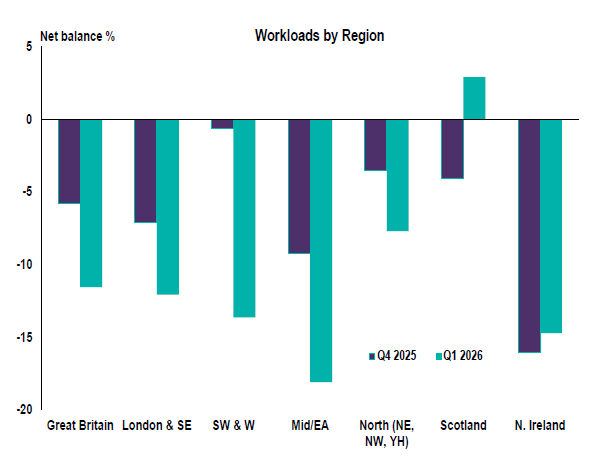
Overall construction activity in Scotland remained relatively subdued through the first quarter of the year, according to the latest Royal Institution of Chartered Surveyors (RICS) Construction Monitor, but housebuilding activity appears to have risen.
A net balance of 3% of survey respondents reported a rise in construction workloads in Scotland in Q1 2026, up slightly from the -4% that was seen in the last quarter of 2025. Scotland is also the only UK region to see this balance in positive territory.
Looking at the subsectors, private industrials, infrastructure and private commercial were all seen to be broadly flat whilst other public works saw a fall in activity (a net balance of -13%). Housebuilding activity did see a rise in workloads across both public sector housing (a net balance of 11%) and private sector housing (a net balance of 10%).


Looking ahead, a net balance of 10% of Scottish respondents expect overall workloads to rise over the next year, and whilst remaining in positive territory, is down from the 24% seen in Q4 2025.
However, with the geopolitical challenges and their impact on inflation, the picture for profit margins appears to have worsened. A net balance of -20% of respondents anticipate profit margins will fall over the next year, falling from the -6% seen in the survey previous.
Surveyors in Scotland continue to report skills shortages, 51% of survey respondents noted a shortage of quantity surveyors, down from 58% in the last survey, 41% reported a shortage of bricklayers, up from 37% in Q4 2025 and 46% report a shortage of other construction professionals, which is higher than the 33% reported in the survey prior.
Survey respondent Shirley Thomson of BDG Thomson Gray Ltd in Aberdeen said: “Lack of certainty of funding for affordable housing.”


Stuart Ferris, DM Hall LLP in Glasgow, added that there’s “high demand and low availability of contractors for specific sectors or specialised types of work.”
Commenting on the UK picture, RICS chief economist, Simon Rubinsohn, said: “The impact of the war in the Middle East is clearly visible in the Q1 RICS Construction Monitor. Rising material costs, a tougher credit environment and increased pressure on margins are already leading some developers to slow construction activity.
“More significantly, plans for the next twelve months are being scaled back most notably in the private sector. Expectations around housebuilding are now flat which aligns with the comments from leading housebuilders in their recent trading updates and results statements.
“Alongside the tougher financial environment, concerns continue to be raised around the challenges thrown up in the planning process and the ongoing impact of the Building Safety Regulator. Even with the passage of the Planning and Infrastructure Act and the improved performance of the BSR, it is evident that both these factors remain significant impediments for developers.”



Share this article:

Subscribe to our newsletter to not miss articles like this one:
 SUBSCRIBE