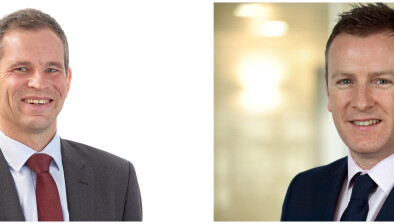





Scott Brewster: Scottish Aggregates Tax can be catalyst for decarbonising construction
 Reading time: 5 minutes

Scott Brewster
In an exclusive for Scottish Construction Now, Scott Brewster, managing director of sustainable resource management company Brewster Brothers, argues that the forthcoming Scottish Aggregates Tax can be used alongside other fiscal levers and environmental policies in order to boost sustainability and emissions reductions in the Scottish construction sector.
For nearly 50 years, Brewster Brothers has evolved in step with Scotland’s shifting economic demands. Starting in agriculture, the business transitioned to property development, including quarry restoration, and, in 2018, into sustainable resource management.
Today, our state-of-the-art wash plants at Drumshoreland and Gartshore have recycled more than two million tonnes of construction, demolition and excavation waste - diverting material from landfill and supplying high-quality recycled aggregates to Scotland’s construction sector at scale.


Simple commercial logic has driven this evolution. Industry responds to where demand is heading, and the product lines developed by Brewster Brothers have been shaped by both market demand and the growing need for resilient and sustainable supply chains in the construction sector.
Thus, our business - and other sustainable resource managers across the Central Belt of Scotland - are well placed to service the requirements of modern housebuilding, energy and infrastructure projects, using advanced innovation and recycling technology.
It is rare for market conditions, technological capability and public policy to align in a way that delivers both commercial and environmental impact. However, the introduction of the Scottish Aggregates Tax (SAT) represents one such moment.
The SAT will replace the UK Aggregates Levy in Scotland on 1 April of this year - giving Scottish Ministers the power to apply a levy on the commercial extraction of virgin sand, gravel and rock.


While at first glance the SAT may appear to be a relatively specialist area of tax policy, the SAT (along with its sister environmental tax, the Scottish Landfill Tax) is an important fiscal tool which can drive carbon reductions and shape material choices across Scotland’s construction sector - at the same supporting the delivery of homes, infrastructure, and energy projects that are vital to Scotland’s economic growth.
The recent Scottish Budget announcement confirmed that the SAT will be introduced at the same rate as is currently applied in England. This will provide continuity for industry in the short term, but also creates an opportunity for the tax to be progressively increased over time. In doing so, Scotland has the potential to be bolder in accelerating the shift towards greater use of recycled and secondary aggregates and reducing reliance on virgin materials.
This is more nuanced than simply discouraging the extraction and use of virgin materials. What we need to see is a move towards using the appropriate product for the appropriate application, preserving our natural resources for higher value uses such as structural concrete and highway asphalt.
This is a move which is increasingly urgent, given that the Scottish Government’s most recent survey in 2019 found that there were only 18 years’ worth of sands and gravels left in Scotland’s quarries.


Clearly, there is a commercial interest for Brewster Brothers and other sustainable resource management companies in the implementation of a progressive SAT. However, a more competitive price differential between virgin and recycled aggregates will create a more confident environment to unlock investment in recycling infrastructure and wash plants like our own, as well as associated logistics networks - all of which are significant growth areas for Scotland’s green economy.
These investments are long-term and almost exclusively regionally anchored, creating skilled employment and resilient supply chains in the areas they service.
There are more profound implications arising from the SAT as well. Encouraging greater recycling within the construction industry would be a significant step forward for Scotland’s net zero targets and circular economy ambitions. The sector currently consumes 50% of the country’s natural resources, generates 50% of its waste, and accounts for 40% of its carbon emissions.
Furthermore, it’s unlikely that the need for sand and gravel, and indeed concrete, will diminish any time soon. Addressing Scotland’s housing emergency means building more homes. Improving the condition of our nation’s public infrastructure - schools, hospitals and roads - will all also require enormous amounts of aggregates.
And so, too, will the delivery of renewable energy projects and associated infrastructure that will defend us against climate change, a major strategic priority for this government. This sustained demand highlights both a commercial imperative and an opportunity for recycled aggregates to become a standard and competitive solution.
The washing technology used during our modern recycling process means that recycled aggregates look (almost) identical, perform as well and are tested to the same standards as their virgin equivalents.
In 2023, Brewster Brothers became the first organisation in the UK to achieve an Environmental Product Declaration (EPD) for recycled aggregates. This gives our customers independently verified data on environmental performance from extraction to end-of-life, and is a clear differentiator in a market increasingly focused on sustainability metrics.
Given the finite nature of virgin material supplies, there is a clear commercial and environmental incentive for the construction industry to adopt recycled aggregates as a practical and readily available alternative. To fully realise this opportunity, bold action is needed to make recycled products the default, rather than an option ‘where possible’.
The SAT provides the fiscal lever to do just that.

Share this article:

Subscribe to our newsletter to not miss articles like this one:
 SUBSCRIBE