




UK construction downturn eases but industry ends 2025 deep in contraction
 Reading time: 5 minutes
UK construction output fell sharply again in December as weak demand, fragile client confidence and delayed investment decisions continued to weigh on the sector — though the pace of decline eased from November’s five‑and‑a‑half‑year lows.
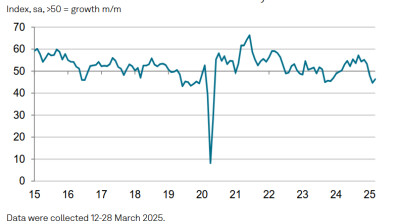
The latest S&P Global UK Construction Purchasing Managers’ Index posted 40.1 in December, up slightly from 39.4 in November but still well below the neutral 50.0 threshold for the twelfth consecutive month. December’s reading marked the second‑weakest performance since May 2020, underscoring the depth of the sector’s downturn.
Civil engineering remained the worst‑performing category, registering 32.9 on the index despite a softer rate of contraction than in November. Housing activity fell to 33.5 and commercial construction to 42.0 — both recording their steepest declines since the early pandemic period.


Survey respondents pointed to subdued demand and fragile client confidence as key factors behind falling workloads. Many firms also cited delayed investment decisions ahead of the November Budget, which continued to drag on sales pipelines into year‑end.
December saw another sharp fall in new orders, extending a full year of monthly declines. However, the rate of contraction eased from November’s extreme levels, offering a modest sign of stabilisation.
Despite the weak flow of new work, business sentiment improved. Around 37% of firms expect output to rise in 2026, compared with 20% forecasting a decline — the strongest level of confidence in five months. Companies pointed to anticipated utilities‑sector projects, including water and energy infrastructure, as well as lower interest rates and improving domestic economic conditions as reasons for renewed optimism.
Construction firms continued to cut employment and input buying in December, though both declines were less severe than in November. Improved expectations for future workloads helped soften the pace of job shedding.


Lower demand for materials contributed to faster supplier delivery times for the fifth month running, with respondents reporting better stock availability and fewer transport issues.
Meanwhile, input price inflation eased to its slowest rate since October 2024, supported by reduced purchasing activity and increased competition among vendors. Subcontractor charges also rose at the weakest pace in just over a year, adding to signs of cooling cost pressures.
Tim Moore, economics director at S&P Global Market Intelligence, said December’s data reflected a sector still under significant strain but no longer deteriorating at the record pace seen in November.
He noted that subdued demand and fragile confidence continued to suppress workloads, while Budget‑related uncertainty had left many clients delaying spending decisions.


Moore added that the fastest reductions were seen in housing and commercial construction, with civil engineering the only segment to show a slower rate of decline. However, he highlighted improving business expectations, driven by anticipated infrastructure spending and hopes that lower borrowing costs and easing inflation could support a recovery in 2026.
Brian Smith, head of cost management at AECOM, added: “This week’s icy conditions somewhat reflect the mood of the construction industry and could prevent a fast start to the year. But, as today’s figures show, things are starting to improve for contractors and January will all be about positioning themselves to gradually expand capacity and be on the front foot to win new work when it comes.
“Everything points towards a further slowdown in inflation and cuts in interest rates to match this year, which will embolden clients and developers to kickstart schemes left on the back burner. However, if everything starts at once, it’s essential that the planning system is equipped to manage the uptick in projects – embracing AI and digital tools to complement the influx of new planners will prove crucial.”
Lynsay Turnbull, regional director at Thomas & Adamson, part of Egis Group, said: “December’s PMI data shows activity continuing to fall sharply across the industry, with housing and commercial construction experiencing their steepest declines since May 2020. Civil engineering remains the sector’s weakest performer, though its rate of decline has eased slightly compared with November.
“Despite subdued demand conditions and fewer new orders to replace completed projects, there are early signs that the market may be starting to stabilise. Business confidence has risen to a five‑month high, supported by forthcoming work in the utilities sector and increased investment in water and energy infrastructure.
“Encouragingly, job losses are also occurring at a slower pace compared to last month due to an improvement in business activity expectations. Input costs have also eased to a 14-month low, signalling stronger supplier performance and contributing to faster delivery times for the fifth consecutive month.
“Looking ahead, the sector shows cautious signs of stabilisation, with rising business confidence and easing cost pressures offering some support. However, persistently weak demand continues to pose risks to the industry.”

Share this article:

Subscribe to our newsletter to not miss articles like this one:
 SUBSCRIBE