



Housing supply falls to near-decade low as social rent waiting lists grow
 Reading time: 5 minutes
New official statistics paint a bleak picture of Scotland’s housing sector, with overall housebuilding continuing to slide and record demand for social housing, despite a modest uptick in social rent starts.
As of 31 March 2024, Scotland’s housing stock stood at an estimated 2.73 million dwellings. Six in ten of these homes were owner-occupied, with social rented properties accounting for 23% of the total. A further 13% were privately rented or occupied rent-free, while 4% sat vacant or were used as second homes.
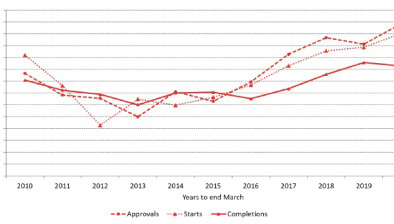
Figures for the year to March 2025 showed 19,779 new homes were added to the housing stock - 628 fewer than the year before, a 3% fall. That made 2024–25 the weakest year for new housing supply since 2017–18, with the sole exception of the pandemic-hit 2020–21. The vast majority of this supply (97%) came from new build homes, with rehabilitations and conversions making up the remaining 3%.


The following year brought little relief. Quarterly data to the end of March 2026 show 17,268 new homes were completed and 14,955 started across Scotland in 2025–26, with completions down 10% and starts down 4% on the previous year. Setting aside the Covid-disrupted 2020–21 period, completions were the lowest since 2016–17, while starts were the lowest since 2012–13 and actually ran 23% below even the pandemic-year low.
The private sector drove much of this decline, with 13,494 completions (down 8%) and 11,018 starts (down 12%). The social sector fared worse on completions with 3,774 homes finished (down 16%), but bucked the overall trend on starts, which rose 25% to 3,937, the one bright spot in an otherwise downbeat set of figures.
Within that social sector activity, the Affordable Housing Supply Programme delivered 6,787 approvals, 7,421 starts and 6,832 completions in 2025–26. Approvals rose 42%, and starts climbed 37% on the year before, though completions fell 8%. Despite the gains in approvals and starts, both remained well short of the 2019–20 peak (47% and 38% below it respectively), and completions were at their lowest since 2015–16.
Toward the Scottish Government’s target of 110,000 affordable homes by 2032 (at least 70% for social rent), 35,368 homes have been delivered so far, split between social rent (77%), affordable rent (14%) and affordable home ownership (8%).


Scotland’s social rented sector grew modestly over the same period, reaching 638,065 homes as of 31 March 2025 - a 1% rise of 5,035 properties on the previous year. Local authorities own a slim majority of this stock (51%), with housing associations holding the remainder.
Councils let more homes but face rising demand and evictions
Local authorities carried out 26,602 permanent lettings in 2024–25, up 5% (1,179 more) on the year before. Homeless households received nearly half of these lets (49%), while 25% went to those on waiting lists, 21% were transfers for existing tenants and 1% fell into other categories.
Eviction activity told a more complicated story. Councils issued 16,543 notices to begin eviction proceedings, broadly flat on 2023–24 but 33% below pre-pandemic 2019–20 levels. Cases that actually ended in eviction or tenants abandoning their homes rose 20% year-on-year to 676, though this remained 41% below pre-pandemic levels.
The temporary eviction moratorium introduced under the Cost of Living (Tenant Protection) (Scotland) Act expired on 31 March 2024, after which eviction orders could once again be enforced as normal. Rent arrears, rather than anti-social behaviour or other causes, accounted for the overwhelming majority (94%) of these cases.
Demand for social housing continues to climb. As of 31 March 2025, 180,074 housing applications were logged across 26 local authority or common housing register waiting lists — up 1% on the year and the highest total since March 2013.
The Scottish Government noted these figures exclude councils without their own housing stock, such as Glasgow, and that some households may appear on multiple lists since applicants can register with more than one council or apply for both council and housing association homes.
Local authorities were providing 20,754 supported houses for older people and 32,111 for people with physical disabilities as of March 2025. Combined, supported housing provision in these categories has grown by 27% over the past ten years.
Support for home repairs and adaptations fell back in 2024–25, with 5,157 Scheme of Assistance grants paid to householders, 881 fewer than the previous year, a 15% drop. Adaptations for disabled residents made up the bulk of grants (3,348). Total spend under the scheme reached £35 million, of which £26.6m went directly to grants.
Separately, the number of houses in multiple occupation licences in force rose 1% to 15,449 as of 31 March 2025.
Responding to the figures, Gillian McLees, CIH Scotland’s national director, welcomed the rise in social housing starts but warned it was an isolated positive: ”(These) housing figures show a 25% increase in social homes started, which is welcome news, however, this is the only increase with completions down across all tenures.
“Scotland is not building at the pace required to meet housing need or tackle homelessness. CIH Scotland’s recent evidence submission to the pre-budget scrutiny consultation highlights that failing to meet people’s housing needs risks prolonging the existing housing emergency and will increase costs for the NHS and other partners. We urge the government to work with the sector to fund and deliver the homes Scotland urgently needs.”

Share this article:

Subscribe to our newsletter to not miss articles like this one:
 SUBSCRIBE