




Written by:

MFMac and Axiom Advocates join forces as legal sponsors for Scottish Construction Summit
 Reading time: 8 minutes
Written by:
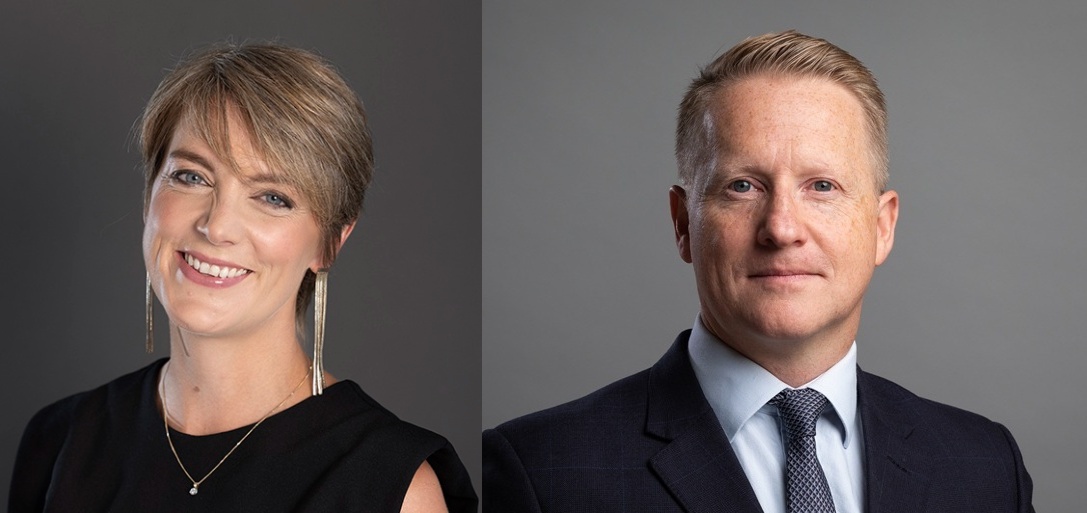
Jen McKay, partner at MFMac, and Axiom Advocates chair Gavin Walker KC
Two of Scotland’s best-known legal names are coming together for this year’s Scottish Construction Summit, with Morton Fraser MacRoberts (MFMac) and Axiom Advocates confirmed as joint legal sponsors of the event, which moves this year to the SEC Campus in Glasgow.
The decision to co-sponsor was felt by both organisations to be a natural fit. Jennifer McKay, partner at MFMac, told SCN editor Kieran Findlay that the pairing reflects two players that already work closely together and share a common objective advising clients across the Scottish construction market.
“There is very much a natural synergy between our two brands,” Jennifer McKay explains. “We are both Scottish, very well established in the market, and see ourselves as leaders in the construction field.” Being embedded in the industry, she says, made the joint sponsorship feel like an obvious step.

Gavin Walker, chair at Axiom Advocates, agrees, pointing out that while Axiom has a presence south of the border, Scotland remains its home and principal source of work. Pairing with a firm of MFMac’s standing in that market, he says, was a straightforward call.
The event itself was the other draw. Building on a strong showing last year at the University of Strathclyde, the Summit’s move to the SEC Campus, along with a speaker line-up drawing from the Scottish Government, the Scottish Futures Trust and major public and private sector players, made it a platform both firms wanted to be part of.
Asked about what specifically prompted the move now, Jennifer McKay points to three forces converging on the construction and legal sectors at once: the arrival of artificial intelligence, a difficult macroeconomic backdrop, and the impact of new building safety and other legislation. All three, she added, make face-to-face conversations with the industry critically important.
For Gavin Walker, the appeal is more fundamental. Advocates, unlike solicitors, rarely get to meet the end client. “The solicitors are our clients and we get to see the end users only through the solicitors, and that’s right and that’s proper,” he says – but it means events like the Summit, complete with a stand and direct contact with attendees, will provide Axiom’s team with firsthand insight into the industry’s requirements and allow clients to meet us in a different environment.


Artificial intelligence emerged as one of the interview’s dominant themes. Jennifer McKay is candid that AI represents “a huge challenge for us all, no matter what industry you’re in,” and that its impact on the legal profession specifically is already being felt – not least in relation to training programmes for junior lawyers. Investment in resources is critical to ensuring the subject matter expertise of the future generation, which must be balanced with maximising the efficiencies created by AI.
Her starting point is data management and control. Before firms can fully implement AI to create efficiencies for clients, she argues, they need to have their own data management and confidentiality obligations firmly in hand. Only once that foundation is in place can firms begin passing on the benefits of AI-driven efficiency to clients – something she believes is particularly achievable in faster, more informal routes to dispute resolution such as adjudication.
But she is equally clear that AI is “not a silver bullet,” warning of the risk of “hallucinated” outputs and stressing that the human element in legal work cannot be dialled down or replicated, even as the technology advances.
Gavin Walker’s perspective from the bar reinforces the point. Courts are increasingly encountering fabricated case citations and non-existent authorities in written submissions, particularly – though not exclusively – from party litigants, and the judiciary has begun taking a harder line in response.


His concern runs deeper than fabricated citations, though. Commercial litigation is fought on the detail. The detail is found in the papers. The solicitor or advocate who relies on AI-generated summaries of the papers will never understand the detail. The risk to the client in that situation becomes enormous.
Anyone who has spent time grappling with technical liability reports, for example, will know only too well that the executive summary is a very useful snapshot but no substitute for turning the pages. The same is true of AI.
Asked whether their perspectives on construction disputes diverge, both organisations were clear that the roles are complementary. MFMac’s solicitors are typically involved from an early stage, advising clients throughout a construction project from procurement and contract negotiation right through to potential disputes which they seek to avoid where possible and resolve proactively. The expertise of the Scottish bar, on the other hand, is usually deployed to prepare opinions on various matters (from procurement through to any disputes), and advocate positions to independent decision makers in written and oral submissions.
Gavin Walker describes the relationship as symbiotic, and is frank about why the split works. Advocates, he notes, are largely insulated from the client-facing demands, the phone calls, the hand-holding, that solicitors have to juggle alongside preparing for court. Each branch of the profession benefits from the skills and attributes of the other.
On misconceptions around construction disputes, Gavin Walker resists a single answer, insisting that no two disputes are alike. Some resolve in a matter of weeks through straightforward negotiation; others run for years. Adjudication, introduced to speed up the process, has reshaped the market over the past two decades, but Walker notes it doesn’t always deliver the quick resolution it promises, particularly on high-value final account disputes.
Jennifer McKay expands on this: adjudication works well when used as intended – fast, interim binding decisions that let parties move on with cash flow secured. But for large final account or defect disputes, an interim binding decision often leaves one party sufficiently unhappy that the matter ends up heading to full determination anyway, raising real questions about whether adjudication is always the cost effective forum.
The comparative underuse of arbitration in the sector, she adds, is a live question and one that clients should be more willing to consider in certain cases. Many larger adjudication disputes, for example, are more like arbitration.
Their advice to contractors and developers keen to avoid disputes altogether is simple: come in early. Both stress the value of early intervention – addressing issues before they escalate into entrenched positions – and the availability of early opinions on contractual interpretation before problems take hold.
On whether disputes are rising or falling, Jennifer McKay senses a modest recent dip. While the exact cause is up for debate, she suggested a possible factor may be clients experimenting in direct use of AI, while stopping short of calling it a significant trend.
Beyond the sponsorship itself, both Jennifer McKay and Gavin Walker frame their involvement in the Summit around relationship-building – strengthening existing connections with contractors, consultants and others in the industry, and forging new ones, while getting a clearer sense of the challenges and opportunities those in the sector are facing.
For Gavin Walker, there’s a specific ambition: for contractors and consultants to start asking their solicitors for “an Axiom advocate” by name, on the strength of a reputation built partly through events like this one. Axiom, he notes, is typically well represented across the major multi-party construction cases heard in the Court of Session – a track record he’d like to see translate into even more direct recognition among the wider industry, not just among the solicitors who instruct the stable.
Jennifer McKay and Gavin Walker’s colleagues Garry Borland KC and David Thomson KC will be taking part on the day, with the current plan built around a series of short, topic-led sessions – likely around fifteen minutes apiece – featuring speakers from both organisations. Gavin Walker is keen to avoid anything resembling a dry legal lecture.
Jennifer McKay agrees that there is no shortage of live issues to draw on: the Commercial Payments Bill and its implications for retention and new powers for the Small Business Commissioner, the continuing relevance of the Building Safety Act, the building safety levy and – inevitably – the perennially divisive topic of prescription, an issue she says the industry still needs to stay across given the significance of recent decisions in the area which have created uncertainty for, and continue to create disputes between, developers, contractors, consultants and asset owners.
With the Scottish construction industry gathering in one place, both organisations see the Summit as an opportunity too good to pass up. As Gavin Walker puts it, it’s a chance to join the “big players” in an event built around the market they call home.
Register Now
With a full programme taking shape and a free-to-attend format, places are expected to fill quickly. Delegates are encouraged to register early to secure their spot.
Register now — free to attend.
To sponsor or exhibit, contact Commercial Director, Raymond Carr: Raymond@scottishnews.com or 07956242860

Share this article:

Subscribe to our newsletter to not miss articles like this one:
 SUBSCRIBE