





New tool launched to accurately forecast retrofit workforce
 Reading time: 4 minutes
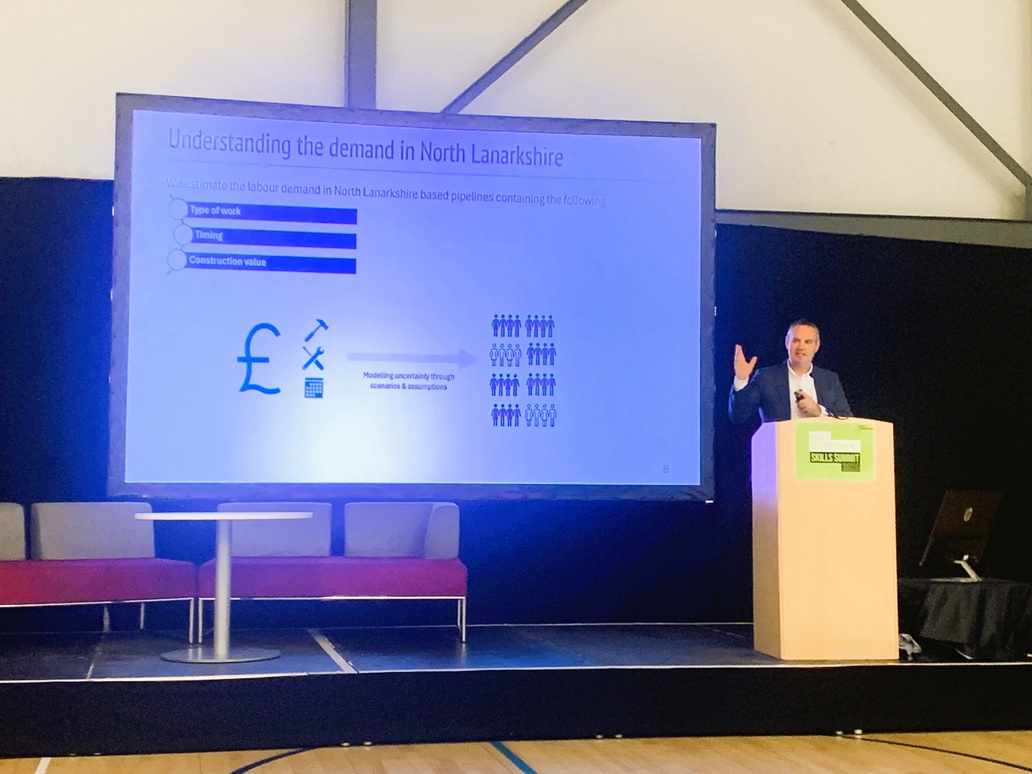
Doug Forbes, Whole Life Consultants director, presenting at the North Lanarkshire Built Environment Skills Summit
A new tool has been launched that translates housing energy data into region-specific workforce insights to support local authorities and delivery partners in planning retrofit programmes.
As retrofit activity accelerates across the UK in response to rising energy bills, fuel poverty and statutory net zero commitments, one constraint is emerging consistently across regions: the availability of skilled labour at the scale and pace required. While retrofit targets are increasingly well defined, workforce implications are often not.
Whole Life Consultants Ltd said its Low Carbon Retrofit Skills Forecasts address this gap by converting housing energy data into clear, quantified, time-phased labour demand, providing decision-makers with the evidence needed to align policy with delivery capacity.


Delivered through a digital platform, the Low Carbon Retrofit Skills Forecasts analyse millions of property records across the UK to model the insulation, heating and fabric interventions required to improve energy performance at scale.
By combining property-level EPC data with labour coefficients developed and validated through the Labour Forecasting Tool, the platform translates retrofit activity into precise occupational demand showing:
- how many people are required,
- in which trades,
- when demand peaks, and
- where delivery pressure will emerge.
The interventions assessed - insulation upgrades, heating improvements and fabric enhancements - are the same measures that reduce energy demand, lower household bills and improve living conditions. While EPCs provide the technical input, the value of the forecasts lies in the delivery decisions they enable.


Specifically, the forecasts provide evidence-based assessments of:
- the scale of retrofit activity required locally and regionally,
- the mix of skilled occupations involved, and
- the timing and intensity of workforce demand.
Emerging workforce pressures across the UK
Early applications of the Low Carbon Retrofit Skills Forecasts show consistent and material workforce pressures across different geographies.
Commissioned by North Lanarkshire Council, Whole Life Consultants Ltd quantified the workforce implications of delivering low-carbon retrofit at scale across the local building stock, translating retrofit activity into labour demand across 28 construction occupations. The analysis draws on property-level data and bespoke labour coefficients to reflect both the scale and mix of interventions required.
The findings show that delivering retrofit programmes to support Net Zero targets and improved energy performance in the area would require approximately 29,370 person-years of labour, equivalent to around 5,870 full-time workers over five years, with particular pressure on plumbing, HVAC and electrical installation trades, which are already in high demand.
Depending on rollout assumptions, retrofit activity accounts for 17–45% of total construction labour demand, competing directly with the wider construction pipeline for the same workforce. Making this labour requirement explicit provides a robust evidence base to sequence delivery, target skills investment and manage workforce capacity risk, ensuring that policy ambition is matched by deliverable workforce capacity.
The Built Environment Sector Board is now moving ahead in North Lanarkshire with a detailed action plan that maps out the next steps and supports coordinated delivery across partners.
In Central London, analysis of 1.91 million retrofit interventions across twelve boroughs — comprising 1.67 million domestic EPCs and 240,000 non-domestic EPCs — indicates an average annual labour requirement of between 13,000 and 17,000 workers over the next five years.
Labour demand is highly concentrated, with five trades — building-envelope specialists, plumbing and HVAC trades, construction trades supervisors, scaffolders, and roofers — accounting for 62% of total low-carbon workforce needs, highlighting clear pressure-point roles for skills planning and investment.
In London’s social rented housing stock alone, EPC-recommended improvements require approximately 41,250 person-years of skilled labour, with acute demand for building-envelope specialists, supervisors, scaffolders and roofers. The complete report is available here.
A practical foundation for delivery
The Low Carbon Retrofit Skills Forecasts provide local authorities, skills bodies and delivery partners with the strongest available evidence base for workforce-enabled retrofit delivery.
The insights support:
- shaping regional skills pipelines,
- aligning training provision with genuine local demand,
- targeting investment in pressure-point occupations, and
- planning credible, deliverable routes to net zero.
Crucially, the forecasts move beyond high-level targets to make workforce implications explicit, enabling informed decisions at the point where delivery risk is highest.
“We are pleased to be part of a practical, region-by-region effort to turn retrofit objectives into something deliverable,” said Oana Niculita, head of development at Whole Life Consultants.
“By making the workforce requirements explicit, our forecasts help local partners plan skills, training and projects together. They show not only where capacity exists, but also where the gaps are likely to emerge, so that warmer homes and lower-carbon ambitions are supported by the right skills at the right time.”

Share this article:

Subscribe to our newsletter to not miss articles like this one:
 SUBSCRIBE