






Black & Veatch launches energy policy recommendations for Scotland
 Reading time: 4 minutes
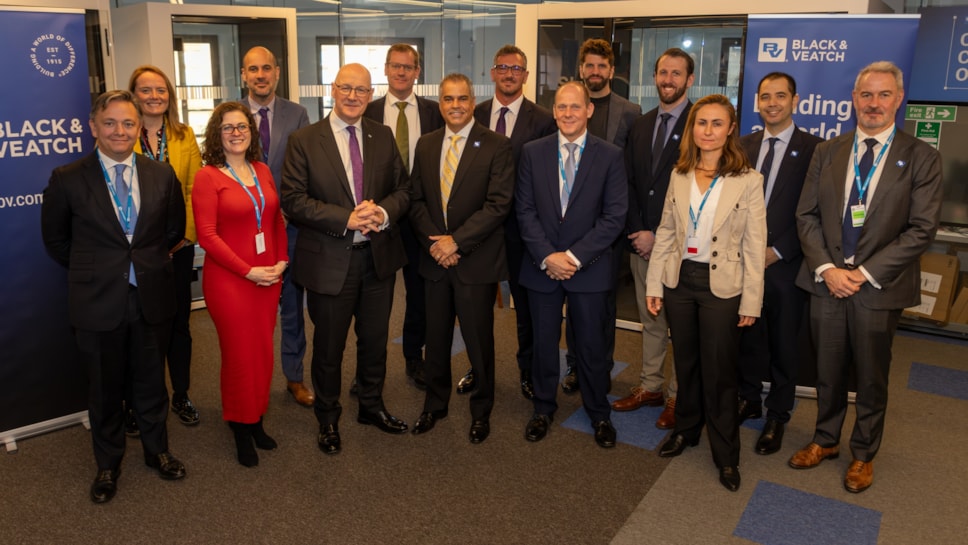
Engineering, procurement, construction and consulting company Black & Veatch on 17 November introduced ‘Powering Scotland’s Energy Transition’, which is a series of energy policy recommendations for the Scottish Government.
For the launch, first minister of Scotland John Swinney MSP visited Black & Veatch’s EMEA HQ in Glasgow, joining a bilateral meeting with executives, meeting Black & Veatch’s graduate trainees and taking part in a policy-focused energy roundtable with a selection of Black & Veatch’s Scottish client base and partners such as: Apatura, Apeiron, Centrica, Matrix Renewables, Protium, RWE and ScottishPower Renewables, as well as representatives of Scottish Enterprise.
Based on the insights and experience of the company’s engineers and project managers, the recommendations are aimed at helping Scotland fulfil its decarbonisation objectives and create a strong energy system.


The discussions in Glasgow centred around opportunities to accelerate investment in renewable power generation, use battery energy storage systems (BESS) to help manage curtailment, and help the deployment of emerging technologies including hydrogen and sustainable aviation fuel (SAF) to support Scotland’s 2045 net zero goal.
Executives focused on how to deliver further system flexibility and address grid constraints within Scotland.
Rafael E. Frias III, managing director of Black & Veatch for EMEA, Rafael E. Frias III, presented Swinney with the recommendations document.
Its key proposals include:


- Planning reform: publish the timeline for outstanding secondary legislation and guidance, and bring in a new Compulsory Purchase Act to streamline and modernise the planning system for present and future energy projects.
- Battery energy storage systems (BESS): keep BESS projects of scale in the local consenting system to make sure applications can work through the process in a timely way and publish the Call for Evidence and timetable for a BESS policy statement.
Frias said: “Few countries have made as much progress as Scotland on deploying renewable energy and committing to an ambitious net zero target.
“The opportunity for us as engineers is to follow through on that progress, working with the First Minister and our partners to deliver the critical infrastructure the energy transition needs.
“Our policy recommendations are a fresh approach for Black & Veatch, supporting clients, partners and ministers with their plans. Drawing on our 110-year legacy of world-class engineering around the world, we are ready to accelerate the work and build an energy system that works for Scotland.”
John Swinney MSP, first minister of Scotland, said: “A just transition means listening to everyone who has a part in it, including businesses, workers and communities, and we will fully consider these proposals by Black and Veatch.
“I am determined to work with industry so that the move to net zero creates good jobs, strengthens our energy security and is fair to people across Scotland.”
Adam Ezzamel, RWE Scotland director, said: “RWE has a strong footprint in Scotland and we believe the country has the resources and expertise to be at the forefront of the energy transition.
“But ambition now needs to be matched by delivery.”
Ezzamel added: “Faster grid connections and a more predictable planning system will be critical to unlocking investment and delivering new clean energy projects.”
Kim McCann, chief commercial officer, Protium said: “Scotland’s renewable surplus should become a local asset, not wasted power.
“Turning it into green hydrogen means fuel made in Scotland, less exposure to global markets and stronger energy security.”
Will Moss, co-founder and chief executive officer of Apeiron Energy, said: “Scotland has the opportunity to play an important role in the global adoption of Sustainable Aviation Fuel.
“At Apeiron Energy, we are progressing plans for a commercial-scale project in Scotland that will convert residual household waste into Sustainable Aviation Fuel - helping to support aviation’s decarbonisation transition.”

Share this article:

Subscribe to our newsletter to not miss articles like this one:
 SUBSCRIBE


