




Dr Jocelyne Fleming: What can Scotland’s historic environment do for our communities?
 Reading time: 4 minutes

Dr Jocelyne Fleming, CIOB’s Scottish policy and public affairs lead, uses the CIOB Column to discuss the purpose of Scotland’s historic buildings and considers how they can be used to tackle challenges facing communities today.
Scotland’s historic buildings were not built to serve as static backdrops for tourist photographs, to be admired from a distance, nor to merely serve as the venue for the occasional conservation-focused committee meeting.
They were built for people.

The buildings we now describe as heritage assets were constructed to house, educate, employ, support, and connect communities. If we are serious about ensuring Scotland’s historic environment has a thriving future, then we need to give more thought and greater priority to how these buildings and places can be used to help tackle the challenges we’re facing today.
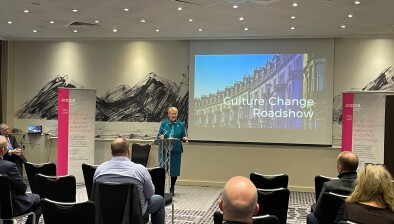
I was recently asked to speak at the Scottish Historic Environment Forum and consider the question “why does the historic environment matter right now?”
My argument was a simple one.
Scotland is currently facing a series of profound, interlinked challenges. We are grappling with a housing emergency, climate change, skills shortages, economic inequality, and growing concerns around community wellbeing.


We often ask how these challenges affect the historic environment. Instead, I argued we should spend more time asking how the historic environment can help address them.
For instance, we could look at the way heritage investment is distributed. John Gilbert Architects have noted that some of Glasgow’s most significant listed buildings in poorer communities have been left vacant and deteriorating because the economics of restoration don’t stack up. Yet, these are often the very communities that could benefit most from the services, homes, identity and opportunities these buildings could bring. To me, that raises an important question: if these buildings were constructed to serve people, what happens when the communities that need them most are unable to benefit from them?
In discussions on climate change, the housing emergency, rising homelessness, and community wealth and well-being, the heritage sector speaks about itself as though it exists outside of the human aspects of these challenges.
I argue the opposite.


The historic environment has always been deeply connected to the pressing, systemic issues of the day. After all, historic buildings were built for a purpose. More importantly, they were built for people.
The buildings we now describe as ‘heritage assets’ were not built accidentally. They were not built simply to exist or to fill space. They were not constructed to sit empty, frozen in time.
Nobody set out to build a historic church, listed school, or perfectly preserved town hall. They built places for worship, learning, work, shelter and community. These buildings were not created to sit apart from society. They were created to serve it.
These buildings shaped the lives of the people who used them. Sometimes every day, sometimes only briefly, but always intentionally.
I don’t believe the people who built Scotland’s beautiful, historic buildings imagined that, centuries later, our greatest ambition for them would simply be preservation in isolation from social challenges. I think they imagined continuity of purpose. Not necessarily the same purpose, but a purpose nonetheless.
I don’t think any stonemason looked to his colleagues and said, ‘Man, I hope someday this place is used two Thursdays a month for a committee meeting.’
Ultimately, the historic environment matters now more than ever because it is connected to the challenges Scotland faces today, not because it sits apart from them.
Historic buildings can support housing delivery. They can anchor communities. They can contribute to climate resilience through retrofit and reuse. They can sustain local skills and craft knowledge. They can help address inequality and create identity, belonging and wellbeing in places that need all three.
We need to stop thinking about heritage as something that merely needs to be protected from change and start thinking more actively about how heritage can affect change, and how it can help shape Scotland’s future.
Instead of asking only how today’s challenges affect the historic environment, we should spend more time asking how the historic environment can help address today’s challenges.
The question, then, is not what Scotland’s communities can do for the historic environment, but what the historic environment can do for Scotland’s communities.
Because these buildings weren’t built just to survive.
They were built to serve.

Share this article:

Subscribe to our newsletter to not miss articles like this one:
 SUBSCRIBE